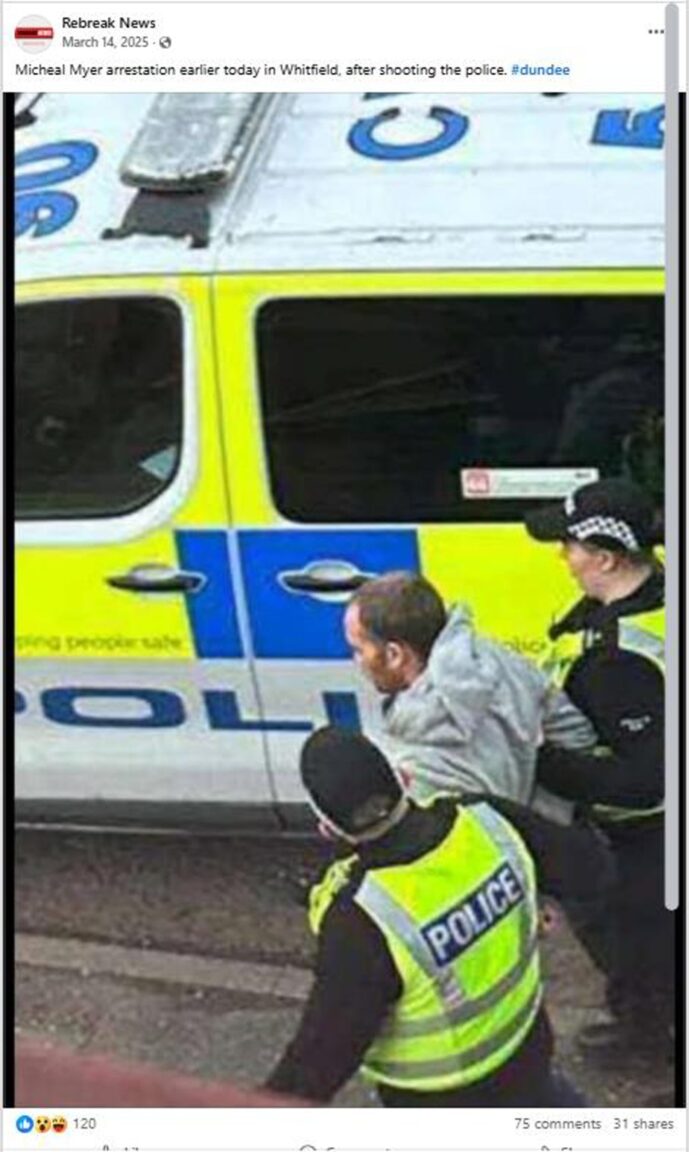
This in the Courier may be of interest, because it's relevant to quite a lot of the press reports and other stuff on here. And, of course, whatever people post on here could potentially be in contempt of court

Not that I've ever posted anything on here that could fall foul of the law as outlined below

(There are slight differences between Scotland and England regarding all this, but I think the fundamentals are the same in both jurisdictions.)
Rebreak News: Could ‘irresponsible’ posts by controversial Dundee site affect criminal trials?https://www.thecourier.co.uk/fp/news/54 ... al-trials/Legal experts have their say on content being posted on social media about live criminal cases.A controversial Dundee ‘news’ site has been accused of potentially putting criminal proceedings at risk with “wholly irresponsible” content on its pages.
Rebreak News, which also posts under the name Rebreak Scotland, shares clips of incidents in and around Dundee – supplied by members of the public – across multiple social media platforms.
Many of these posts show serious crimes being committed and anti-social behaviour.
Content shared via Rebreak also includes speculation and commentary on live criminal proceedings or identifies those accused of or victims of crimes.
The Courier has already spoken to parents and other high-profile Dundee figures who have criticised Rebreak for sharing content featuring children and exploiting vulnerable people.
We have also looked at who runs Rebreak, including speaking to a former contributor.
Now, following concerns that the pages’ activities could affect the fair application of justice, we examine the impact Rebreak’s posts could have on criminal trials.
Strict rules on publishing content about live criminal casesThe Contempt of Court Act 1981 places strict rules on what can be published about a live criminal case.
A case is deemed live as soon as someone has been arrested, and remains so either until the conclusion of a trial or the case against them is dropped.
This often means a case is deemed live for contempt of court purposes for several months or even years.
Media outlets have more freedom before an arrest has been made, though they are still governed by the Independent Press Standards Organisation’s (Ipso) editors’ code of conduct in areas like accuracy and privacy, as well as privacy laws.
Contempt of court laws are designed to ensure media outlets cannot influence potential jurors, who are asked only to consider the evidence given to them in a courtroom.
However, the legislation stretches to any type of publication, including content being posted on social media.
In theory, it means a member of the public could be prosecuted for contempt of court for publishing content relating to a live case on their own Facebook page.
Professor Colin Reid, a public law expert from Dundee University, says contempt of court laws are in place to “ensure a fair trial” and work on the basis that people are innocent until proven guilty.
“The decision whether they are guilty or not should be based on the evidence that is allowed to be admitted in court, not on general rumour or gossip outside,” he said.
Contempt of court rules explainedAccording to the Crown Office and Procurator Fiscal Service (COPFS), posting about active cases on social media must not include commentary or analysis of evidence, witnesses or the accused.
This is why readers will often see the comments disabled on The Courier and Evening Telegraph’s Facebook pages when proceedings are still active, as the publisher is responsible for this content, even if the comments are left by another person.
Anyone convicted of contempt of court can face prison or a fine.
The Courier has seen several examples of content on Rebreak’s pages that discuss or even share images relating to live criminal cases.
One involved Rebreak posting a picture of a man being arrested after a crossbow was repeatedly discharged in Whitfield last year.
The picture clearly showed the man, Michael Ley, being led away by police on the day of his arrest – though the caption carried the wrong name of “Micheal Myer”.
https://wpcluster.dctdigital.com/wp-con ... 9x1152.jpgMedia titles are not allowed to publish a photo of a suspect like this, usually until they have been convicted or cleared, in case there is any dispute over their identity.
Another photo from the incident showed police cars on the street with a caption stating as fact that he had shot police, well before the case had even gone to court.
It said: “Most of yours (sic) probably already seen the video of Michael shooting the police. #dundee from what we’ve been told he is in hospital and alive.”
We can only highlight this example now that Leys has been convicted and the case is no longer live.
However, The Courier has seen several other examples of posts on Rebreak’s pages about live criminal cases, including speculation, potential evidence and witness accounts related to two alleged murders.
We cannot go into specifics on these at this stage, as both cases remain live.
Expert’s prosecution warning over social media contentProf Reid admits that applying contempt of court laws to social media can be difficult, but this does not mean people should not take care over what they post.
He said: “The legal test is if there is a substantial risk that the course of justice will be seriously impeded or prejudiced.
“Severe cases of contempt can lead to the criminal prosecution failing, but the standard for that is really quite high.
“The courts don’t want to have people who they think might be guilty getting away because of things posted on social media.”
We showed the posts mentioned above to Angela Wilson, the former assistant chief constable of the legacy Tayside Police force.
She described the content as “wholly irresponsible”.
She has argued for greater controls on social media to prevent “the unintended consequence” of posting information that “could be really detrimental to investigations”.
“You have got very strict rules, particularly when somebody’s been arrested and then charged, there are certain things you can report,” Ms Wilson said.
“I know sometimes the public might get frustrated because they want to know more, but going to social media, you’re not necessarily going to get the correct version.
“I think that sometimes it’s about re-educating the public. Some rules are there for a reason; they’re very sensible.
“As a serving police officer, you were always between a rock and a hard place and in really sensitive cases, there was always a real discussion about what information was appropriate to release, and what wasn’t.
‘Social media is a challenge for the justice system’“I think the police do a really good job of putting appeals on social media and sharing information where it’s appropriate, especially if they’re asking for witnesses.
“It’s important to get the information out there when it’s appropriate. But it’s always thinking about the other side of this.”
Ryan MacDonald, a retired Tayside police officer, has also shared his concerns about the impact content posted on Rebreak could have on investigations.
He said: “When highly emotive or one-sided content is shared with large audiences, it can shape public opinion, affect witness recollection, and make investigators’ jobs much harder.
“This isn’t about censoring people or stopping legitimate reporting, it’s about recognising that courts operate on evidence, not online narratives.
“In practical terms, this kind of content can delay proceedings, create grounds for legal challenge, or, in extreme cases, risk a trial being ruled unfair.
“Any platform sharing material about live investigations needs to understand that responsibility.”
Top criminal defence lawyer has say on Rebreak News contentHowever, even though the Contempt of Court Act 1981 applies to social media sites the same way it applies to news outlets in theory, one law expert says prosecuting those responsible can be difficult.
The Courier asked Thomas Ross KC, one of Scotland’s leading criminal defence lawyers, for his opinion on Rebreak’s content.
Mr Ross said: “Social media is a challenge for the justice system, made worse by the rise of citizen journalism – if that’s what you want to call it.
“Jurors are always told as preliminary direction not search for any information about the case, and to only make decisions based on the evidence given in court.
“I don’t know if (Rebreak’s posts) are in contempt of court, as the material risk of prejudice has to be pretty high, and there’s an assumption that the information posted on the internet is not necessarily accurate.”
Mr Ross added: “Unlike the established press, there’s much less jeopardy for these pages.
“How do you go about identifying who is actually running these pages, and who has posted the material online?”
We also put some examples of content published by Rebreak to the COPFS, asking what impact social media posts could have on criminal trials in Scotland.
Crown Office urges social media users to ‘exercise caution’In response, a spokesperson warned individuals to “exercise caution” when publishing content that could affect court proceedings.
A COPFS spokesperson said: “It is important that the authority of the court and the integrity of proceedings are upheld and protected.
“Any allegation of conduct which creates a substantial risk of serious prejudice or impedes the course of justice will be appropriately considered.
“The provisions of the Contempt of Court Act 1981 protect the integrity of proceedings, preserve access to justice for victims and secure the rights of people accused of crime.
“Anyone publishing items about active cases is advised to exercise caution as material must not be commentary or analysis of evidence, witnesses or accused.”
The Courier also asked Angela Constance, Scotland’s justice secretary, for an interview on the matter, but she declined the offer.
A Scottish Government spokesperson simply said it was a matter for COPFS.
Rebreak has not responded to a request for comment.
Rebreak claims it doesn’t publish names and faces – despite Courier’s findingsHowever, Rebreak Scotland put out a lengthy statement on Wednesday, claiming it was not responsible for fuelling violence and anti-social behaviour in the city.
The page also claimed it “does not share faces or names because we do not want individuals to be publicly shamed” – despite The Courier’s investigation highlighting numerous cases where content shared by Rebreak features people’s faces and, on occasion, names, including those of children and vulnerable people.
Rebreak also said it had asked one of its members to “start an educational podcast for the community”.

 Login
Login Register
 FAQ
FAQ